
The four patches of rubber touching the road affect how a vehicle steers, brakes, accelerates, and handles bad weather. Yet many drivers notice their wheels only after a dashboard warning appears. A simple tire care routine can improve awareness of developing problems and help you choose replacements that fit your vehicle and driving conditions.
You do not need to become a mechanic to make better decisions. Learn where to find the correct pressure, how to recognize worn tread, what sidewall markings mean, and when a professional inspection is necessary. This guide focuses on everyday passenger cars, SUVs, and light trucks driven in the United States, where weather and road conditions can change dramatically between regions.
Why the Contact Patch Deserves Attention
A tire is not a solid ring of rubber. Its construction includes an air-retaining inner liner, reinforcing cords and belts, sidewalls, beads that secure it to the wheel, and a tread surface designed for contact with pavement. These parts work together to carry the vehicle’s load while absorbing irregularities and transmitting steering and braking forces.
For a helpful look inside the construction and terminology, Universal Technical Institute’s tire guide explains materials, sizing, alignment, and rotation from a technician’s perspective. Understanding those basics makes conversations at a service counter more productive. UTI Corporate
Grip Depends on More Than Tread Appearance
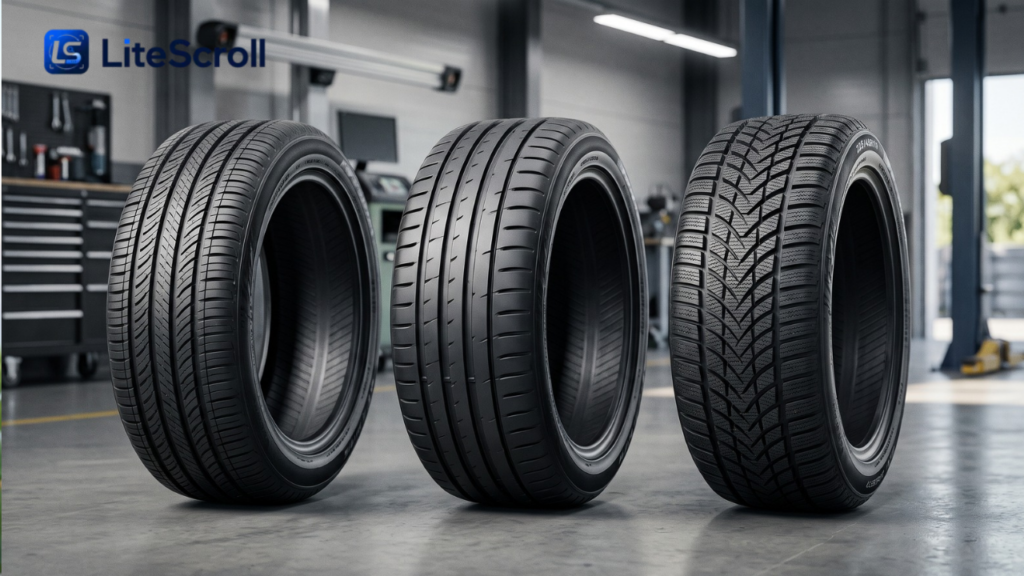
Rubber compound, temperature, road texture, water depth, inflation, and tread design all influence available grip. A sporty pattern may look impressive but perform differently from an all-season design in freezing conditions. Likewise, a tire with visible grooves can still be unsuitable because of age, physical damage, or uneven wear.
Decode the Numbers on the Sidewall
Sidewall markings communicate dimensions and operating limits. Consider a hypothetical size such as 225/60R17 99H. The numbers are not an instruction to purchase that size; they demonstrate how a common service description works.
- 225: nominal section width in millimeters.
- 60: sidewall height expressed as a percentage of section width.
- R: radial construction.
- 17: wheel diameter in inches.
- 99: load index, which corresponds to a standardized load capacity.
- H: speed rating under specified test conditions.
The right tire size is usually listed on the vehicle’s driver-door placard and in its owner’s manual. Compare that specification with the current sidewall. Tire Rack
Understand Load and Speed Ratings
The load index indicates capacity under defined conditions; the speed symbol identifies a tested capability, not a recommended driving speed. Replacements must meet the vehicle manufacturer’s requirements for fitment, load capacity, and other relevant specifications. Ask a qualified installer before changing dimensions or mixing designs.
A tire that physically fits a wheel is not necessarily appropriate for the vehicle. Prioritize the specified fitment over appearance or a tempting discount.
Read the Manufacturing Date
In the United States, the final four digits of the complete DOT identification number generally show the week and year of manufacture. For example, 2325 means the 23rd week of 2025. The complete number may appear on only one side, so checking the inner sidewall may be necessary. NHTSA
Age alone is not the only consideration. Storage, heat exposure, maintenance, and visible damage matter, too. Follow your vehicle and tire manufacturers’ guidance on service life, and ask for a professional assessment if the history is uncertain.
Set Inflation Pressure the Right Way
Correct pressure supports the intended contact with the road and helps control heat buildup and wear. Underinflation can increase flexing and damage risk; overinflation may change handling and wear characteristics. Neither condition should be ignored simply because the vehicle seems to drive normally.
For most passenger vehicles, look for the recommended cold inflation pressure on the driver-door placard or in the owner’s manual. Do not substitute the maximum pressure molded into the tire sidewall. That maximum is not automatically the vehicle’s recommended operating pressure. NHTSA
A Reliable Monthly Pressure Check
- Park the vehicle for at least three hours before checking, when practical.
- Use a dependable gauge on each road wheel and the spare, if fitted.
- Compare readings with the correct placard values for the vehicle and load conditions.
- Add or release air as needed, then recheck with the gauge.
- Replace valve caps and note any wheel that repeatedly loses pressure.
Check the tire pressure at least monthly and before a long journey. The National Highway Traffic Safety Administration recommends regular cold-pressure checks and inspections for damage. NHTSA
Why a Dashboard Alert Is Not a Gauge
A tire pressure monitoring system is an important warning feature, but it does not replace routine manual checks. Some systems alert only after a meaningful pressure loss, and dashboard behavior varies by vehicle. If the warning appears, find a safe place to inspect the situation and follow the owner’s manual. Do not keep driving on a visibly deflated wheel.
Inspect Tread and Sidewalls Before Trouble Starts
Tread grooves help move water away from the contact area. As depth decreases, wet-road performance can suffer, even before the vehicle feels different in dry weather. A simple measurement gives more useful information than judging the pattern from a distance.
Measure Depth Across the Width
A tread-depth gauge provides a clear reading in thirty-seconds of an inch or millimeters. Measure multiple grooves at several points around each wheel, rather than checking one attractive-looking location. The commonly cited U.S. minimum of 2/32 inch is a last-limit reference, not a promise of strong wet-weather traction. Some conditions justify earlier replacement. NHTSA
Uneven readings can also reveal a developing problem. More wear along the center, shoulders, or a single edge may indicate issues with inflation, alignment, worn components, or driving conditions. Ask the technician to diagnose the pattern before assuming that replacing rubber alone will solve it.
Watch for Cuts, Bulges, and Repeated Leaks
Inspect both visible sidewalls for cracks, cuts, exposed cords, impact damage, or a suspicious bulge. A bulge can indicate internal structural damage and should be treated seriously. If a tire is visibly compromised, stop using it and arrange professional help rather than testing it at highway speed.
When to Seek a Professional Inspection
A persistent vibration, sudden steering change, unusual thumping, or recurring pressure loss merits investigation. Explain when the problem happens so the shop can check the correct systems instead of guessing.
Keep Wear Patterns Consistent
Rotation moves wheel positions according to a vehicle-approved pattern. It can help distribute wear that develops differently between front and rear axles. However, some vehicles use staggered sizes or directional designs that restrict where a wheel can be moved.
Consult the owner’s manual for the tire rotation interval and pattern. An often-quoted mileage range is not a substitute for manufacturer instructions. If a wheel is already developing unusual wear, identify the underlying issue before treating rotation as the repair. UTI Corporate
Distinguish Rotation, Balancing, and Alignment
These services solve different problems. Rotation changes positions; balancing addresses uneven mass distribution in a wheel assembly; alignment adjusts vehicle suspension geometry to specified angles. An alignment may be appropriate after certain impacts, repairs, or uneven-wear findings, but not every vibration proves the angles are wrong.
Request measurements or an explanation before approving work. A conscientious technician can show why a particular service is needed and what outcome to expect.
Choose Replacements Based on Real Driving
When shopping, start with manufacturer-approved dimensions, load requirements, and the conditions you encounter most. A commuter in a mild climate may have different priorities from someone who regularly drives on snow-covered mountain roads. Price matters, but fit, safety, seasonal suitability, and warranty terms matter as well.
Compare Common Seasonal Categories
- All-season: intended for a broad range of everyday conditions, though capability varies significantly by model.
- Summer-performance: designed around warmer-weather traction and handling; often unsuitable for freezing conditions.
- Winter: engineered for cold-weather traction, with performance depending on the specific design and road surface.
- All-terrain: often chosen for vehicles that divide time between paved roads and rougher surfaces, with trade-offs in noise and comfort.
Do not assume that every tire marketed as all-season is suitable for severe snow. Check recognized markings, the manufacturer’s application guidance, and the conditions in your area. When buying a complete set, ask about installation, balancing, disposal charges, and any applicable road-hazard coverage.
Replace One, Two, or All Four?
The answer depends on wear, drivetrain, existing fitment, and manufacturer instructions. If replacing fewer than four, obtain model-specific guidance on placement, matching, and acceptable tread differences. Avoid mixing incompatible constructions or specifications.
Know the Limits of Puncture Repair
A nail in the tread does not automatically mean the entire assembly is beyond repair, but repairability cannot be judged from outside alone. The U.S. Tire Manufacturers Association advises removing the assembly from the wheel for internal inspection, limiting repair to an eligible tread-area puncture, and using a method that fills the injury and seals the inner liner. USTMA
A tire with sidewall injury, evidence of internal damage from being driven flat, or a puncture outside the approved repair area may need replacement. Manufacturer policies and specialized construction can impose further restrictions. Avoid relying on an external plug as a permanent substitute for a proper inspection and repair.
Prepare for Changing Weather and Longer Drives
Before a trip, look for damage, measure cold pressure, review tread condition, and inspect the spare or emergency mobility kit. Check that any jack, wrench, or inflator is present and that you understand the vehicle’s instructions. If the car uses a temporary spare, follow its stated operating restrictions.
After a sharp pothole impact or curb strike, inspect the tire and wheel for visible damage and pay attention to new vibrations. Road hazards can affect suspension or wheel condition even when a puncture is not obvious. If a wheel begins losing air rapidly, slow down, move to safety, and arrange assistance.
A Simple Monthly Maintenance Routine
Set one recurring reminder and make the inspection manageable. A useful checklist is:
- Measure cold inflation on every wheel, including an accessible spare.
- Look for embedded objects, cuts, cracks, bulges, and abnormal wear.
- Measure tread at more than one point when wear is noticeable.
- Check the vehicle’s service schedule for upcoming rotation needs.
- Investigate recurring pressure loss rather than repeatedly adding air.
- Review replacement needs before the next season or major journey.
This small habit makes tire maintenance more predictable. It also provides a baseline: when something changes, you are more likely to notice it early and give a professional useful information.
Frequently Asked Questions
How often should inflation be checked?
Check tire pressure at least once a month and before long trips, ideally when the vehicle has been parked for three hours. Use the vehicle’s placard values, not the sidewall maximum. Seasonal temperature swings make regular checks worthwhile.
Is the penny test enough to judge safety?
The penny test can reveal very low tread depth, but it cannot identify every safety issue. A tire may need attention because of damage, uneven wear, age, or poor performance in the conditions you regularly encounter. A depth gauge and full inspection offer more information.
Can I use a different size from the factory specification?
Sometimes an alternative is approved, but fitment needs more than matching wheel diameter. Load rating, clearance, speed rating, and vehicle systems all matter. Ask a qualified professional to confirm the proposed tire against manufacturer guidance.
Does a warning light mean I can still drive?
Not necessarily. A pressure warning calls for checking the vehicle safely, while a visibly flat wheel can be unsafe to drive. Follow the owner’s manual and get assistance if the tire appears damaged or cannot hold inflation.
Is every puncture repairable?
No. Location, size, internal condition, previous repairs, and manufacturer restrictions determine whether repair is appropriate. An authorized technician should inspect the inside before deciding. Damage in the sidewall or shoulder generally rules out a standard puncture repair.
Do new wheels need balancing or alignment?
Newly installed tire assemblies generally require balancing. Alignment is a separate service and is not automatically necessary with every purchase. Ask for an inspection if there is uneven wear, pulling, or a recent suspension impact.
Conclusion
Good wheel care begins with the correct size, cold inflation pressure, and a quick inspection habit. Learn what tread wear and sidewall damage look like, then seek qualified advice when symptoms suggest a deeper issue. Selecting the right tire for your vehicle and climate can make maintenance decisions clearer and road trips less stressful. Consistent attention matters more than waiting for a warning light.