
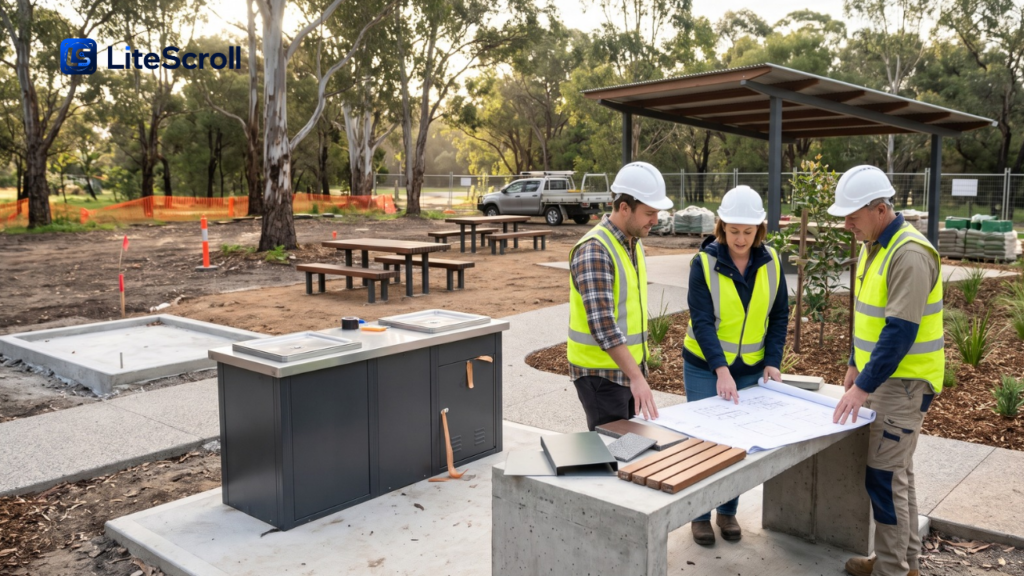
A shared barbecue can turn an ordinary park visit into a family lunch, a neighbourhood celebration, or a relaxed stop on a long drive. But successful cooking areas need more than a working hotplate. When selecting park BBQs, councils and landscape designers must consider who will use them, how people move around them, and how the equipment will be cleaned and repaired over time.
Australian sites face different challenges, from salt air near the coast to high temperatures inland and heavy use on public holidays. This guide explains how to choose park BBQs that suit a location, compare electric equipment, plan inclusive layouts, and budget for dependable public use without relying on exaggerated performance claims.
Begin With the People and the Site
Before choosing a model, estimate how the picnic area is actually used. A small neighbourhood reserve might need one cooking station near existing tables. A destination park with sports grounds may need multiple units arranged to prevent crowding. Good park BBQs are selected for realistic visitor demand, not simply because the largest cabinet looks impressive on a plan.
Observe the site at weekends as well as weekdays. Check where visitors arrive, where children play, and whether people already gather in shaded areas. Include consultation with maintenance workers, who often understand problems that are invisible in an architectural rendering.
Write a Brief Before Requesting Quotes
Specify expected users, approximate peak demand, power availability, access routes, cleaning frequency, and the intended lifespan of the installation. For park BBQs in a coastal reserve, explicitly identify salt exposure; for a school or campground, record supervision and operating requirements. A clear brief allows competing suppliers to quote the same functional outcome.
Understand Why Electric Units Are Popular
Permanent electric hotplates are common in Australian public spaces because they avoid managing gas bottles at individual facilities and can provide timed operation. They still require electrical infrastructure, weather-appropriate components, cleaning, and safe management of hot surfaces. Choosing electric park BBQs does not remove the need for risk assessments, maintenance or appropriate user instructions.
The ACT’s municipal street and park furniture standards, for example, favour electric barbecue equipment where possible and address slab mounting and practical maintenance. That is a useful design reference, but it is not a universal rule for every Australian council. Local specifications and approvals remain important. City Services
Match the Electrical Supply to the Equipment
Determine available supply before finalising a product. GX Outdoors describes 10A and 15A options, with its 15A equipment requiring a suitable dedicated circuit. A licensed electrician should confirm site capacity, compliant outlets, electrical protection and installation arrangements. Park BBQs placed far from existing services may cost substantially more to install than their purchase price suggests. GX Outdoors
Keep Operational Controls Understandable
Simple, visible controls can help first-time visitors. Ask suppliers about timed cooking cycles, start and stop indicators, lockout features, and maintenance access. These features vary between models, so avoid assuming every unit in a product range behaves identically.
Choose Cooking Capacity Without Guesswork
One hotplate may serve a quiet picnic space, while a busy regional park might need several cooking stations. Capacity depends on cooking area, heat recovery, operating cycle, and how visitors use the facility. Park BBQs should be compared using documented specifications and realistic demand, not unsupported promises about how many people each unit will feed.
Consider queues and the space needed for groups waiting safely. Separate cooking stations from playground edges and keep serving areas away from the main accessible path. Placing equipment near picnic tables can improve convenience, but crowding hotplates against seats introduces unnecessary conflict between movement and heat exposure.
Look at Surface Materials and Grease Handling
A durable cooking surface should resist routine cleaning while remaining suitable for food contact. The design also needs a practical way to collect grease. Ask whether removable buckets, liners, traps or service panels are included, and who is responsible for emptying them. For park BBQs, cleaning access often determines whether maintenance remains manageable after the opening ceremony.
Design for Accessibility, Not Just Compliance Labels
People using wheelchairs, walking aids or prams should be able to reach the cooking area without taking an indirect or unsafe route. The 2026 Victorian Design for Everyone guidance highlights continuous accessible paths, circulation space, reachable controls and nearby preparation surfaces. Accessible park BBQs require attention to the surrounding space as well as the appliance itself. Sport and Recreation Victoria
Consider Reach, Clearance and Visibility
Check cooking height, the position and operation of controls, knee clearance where relevant, and sufficient space for approach and turning. The City of Sydney’s inclusive public domain guidance recommends controls usable with an open palm or closed fist and places emphasis on reachable cooking surfaces. A supplier’s accessibility description does not independently certify the completed installation. meetings.cityofsydney.nsw.gov.au
When specifying park BBQs, include accessible picnic seating, firm slip-resistant paths, lighting and clear separation from children running nearby. Request dimensioned drawings and a qualified access review against the standards and local requirements that apply to your project.
Compare Product Ranges With a Consistent Checklist
Australian suppliers offer different cabinets, hotplate arrangements, access features, finishes and service options. Buyers reviewing park BBQs can explore GX Outdoors’ advertised Elite, Edge, Contour, Frontier, Horizon and InBench ranges. The manufacturer describes accessories including splashbacks, lids, extra bench space and grease-management options. Confirm which features come with the selected model rather than assuming the whole catalogue includes them. GX Outdoors
GX Outdoors states that most of its listed barbecue models meet its stated DDA accessibility requirements, but identifies the Edge as an exception. That makes model-by-model review essential. For park BBQs purchased through any supplier, ask for product drawings, current warranty conditions, maintenance instructions and evidence supporting specific technical or accessibility claims.
Avoid Buying on Appearance Alone
A minimalist cabinet may suit a modern waterfront precinct, while another setting calls for stronger visual separation and easy-to-identify controls. Decide which finishes can be cleaned or repaired locally. A coordinated furniture range can look attractive, but a consistent appearance should never outweigh functionality, accessibility or safe upkeep.
Plan Shade, Water, Bins and Seating Together
Cooking areas function as small public destinations. Families need room to prepare food, sit together, wash hands where facilities exist, and dispose of waste. Good park BBQs belong in a site plan that includes picnic tables, bins, drinking water, lighting and access to toilets where practical.
Shade makes waiting and eating more comfortable, but a shelter above a barbecue needs appropriate clearances, ventilation and approval for the specific installation. Do not assume any roof can safely cover any cooking appliance. Consider wind, rainwater runoff and whether smoke or heat may affect nearby users even with electric equipment.
Protect the Main Walking Route
Allow groups to queue and move between stations without blocking the accessible path. Position bins close enough to encourage use but away from the cooking surface. Place preparation ledges where they do not create pinch points. When park BBQs are planned alongside the surrounding furniture, operational problems are easier to identify before concrete is poured.
Make Cleaning and Food Hygiene Practical
Public cooking facilities are shared, so cleanliness depends on both scheduled council maintenance and responsible visitors. Australia’s Federation Council advises users to clean the public barbecue and table before cooking and to handle leftover food safely. Operators should provide clear local guidance and reliable access for cleaning crews. Federation Council
Park BBQs need a maintenance schedule appropriate to visitor numbers and site conditions. That might include checking hotplate condition, emptying grease traps, removing debris, inspecting damaged controls, and cleaning surrounding surfaces. Commercial food vendors or temporary community food stalls may also face separate food-safety obligations; an ordinary park installation does not replace those requirements. Food Standards Australia New Zealand
Design for Easy Repairs
Look for accessible service compartments, replaceable parts and straightforward fault reporting. GX Outdoors describes remote management through its GX360 system for compatible equipment; confirm which models and subscriptions, if any, are required. Park BBQs with useful monitoring features can still fail if nobody is assigned to respond to alerts.
Account for Fire Restrictions and Local Rules
Public cooking rules can change with location, weather and fire danger. State and territory requirements distinguish between fuel types, and rules for privately brought barbecues may differ from installed public equipment. Do not publish a blanket promise that park BBQs can be used during every total fire ban. Check the relevant fire authority, land manager and site notices. City Services+1
Explain operating restrictions through clear signage maintained by the responsible authority. If a unit is out of service, visitors should be able to see that before preparing food. Design controls and enclosure arrangements so unauthorised modification is difficult and trained personnel can isolate equipment safely.
Assess Whole-Life Cost Rather Than Sticker Price
A realistic budget covers design, electrical connection, civil works, foundations, freight, commissioning, cleaning, replacement parts, electricity and eventual refurbishment. Two park BBQs with similar purchase prices can have very different total costs when one requires lengthy trenching or complicated servicing. Ask for an itemised installed quote before comparing suppliers.
Build a Simple Procurement Scorecard
Use consistent criteria for safety, access, cooking performance, parts availability, energy use, maintenance, warranty and delivery. Consider environmental performance through credible information on materials, repairability and operating requirements instead of relying on generic sustainability claims.
Before placing an order for park BBQs, confirm these details:
- Expected users, busy periods and number of cooking stations.
- Suitable access routes, reach clearances and nearby seating.
- Available electrical supply and licensed installation responsibilities.
- Hotplate, cabinet, controls and grease-management specifications.
- Foundations, drainage, shade and surrounding pedestrian circulation.
- Warranty exclusions, spare parts, repairs and cleaning ownership.
- Local permits, fire-management rules and required handover records.
A complete handover should include equipment identification, commissioning records, maintenance instructions and a named team responsible for future inspections.
Frequently Asked Questions
Are electric public barbecues always safer than gas models?
Electric models eliminate the need to store gas at individual units, but they still involve hot surfaces, electricity and public misuse risks. Appropriate design, installation and maintenance matter more than a simple technology label. Evaluate park BBQs against the actual site and supplier instructions.
What should councils check before purchasing equipment?
Confirm capacity, accessibility, electrical supply, service access, installation scope and full lifecycle costs. Compare park BBQs using the same specification sheet so lower prices are not confused with a smaller or incomplete scope.
Can wheelchair users operate community cooking stations?
Some designs provide accessible approaches, controls and work surfaces, but not every model or installation is equivalent. Park BBQs should be assessed as part of the surrounding accessible route, with a qualified review where required.
How often should a public hotplate be cleaned?
Cleaning frequency depends on traffic, food residue, local policy and manufacturer instructions. Park BBQs in busy destinations may need more frequent attention than those in quiet reserves. Visitors should also clean cooking surfaces before use and follow food-safety guidance.
Do cooking stations need special electrical installation?
Permanent electric appliances require a suitable supply installed and checked by appropriately licensed professionals. Requirements depend on the particular model, site and jurisdiction. Do not assume a standard outlet can serve every higher-power unit.
Can these facilities be installed beneath a shelter?
Sometimes, but roof clearance, ventilation, structure, operating conditions and approvals must be evaluated for the proposed equipment. For park BBQs under shelters, seek installation-specific guidance rather than relying on a generic product photograph.
Conclusion
Well-designed public cooking facilities make parks more inviting when they support easy access, safe use and dependable upkeep. Choosing park BBQs involves matching real visitor demand with suitable equipment, electrical infrastructure, inclusive layouts and practical cleaning plans. Compare complete installed costs and verify model-specific claims before ordering. The best long-term outcome is a facility people can enjoy and councils can maintain with confidence.