
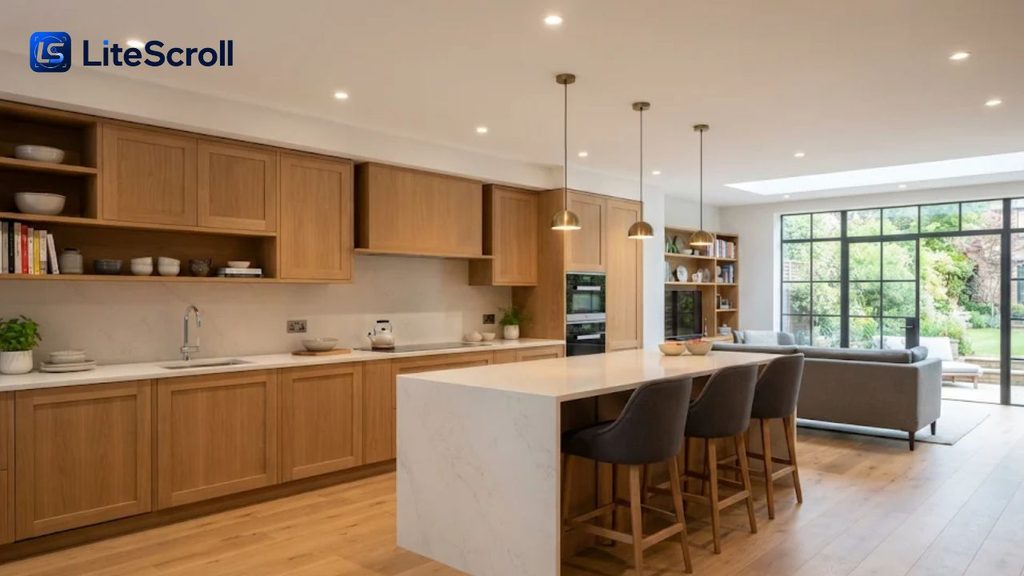
Recessed lighting can make a kitchen feel brighter, create calm bathroom lighting, and keep a ceiling visually uncluttered. But cutting a hole in plasterboard may affect how the ceiling performs during a fire. Choosing fire rated downlights is therefore more than a question of beam angle or bezel colour. The fitting must be suitable for the actual ceiling construction, and the electrical installation must satisfy the relevant safety requirements.
For homeowners comparing fire rated downlights in the United Kingdom, the key is to treat fire performance, electrical protection, moisture resistance, and light quality as separate checks. This guide explains the differences, highlights realistic products available through UK suppliers, and shows how to discuss an installation with a competent electrician.
Why a Recessed Fitting Can Affect a Ceiling
A floor and ceiling may be designed as an assembly that resists fire for a specified period. Making openings for recessed lights changes that construction. Some approved fittings incorporate protective features intended to maintain the assembly’s tested performance when installed correctly. Others require a separately tested protective enclosure or a different design approach.
The purpose of fire rated downlights is not to make a building fireproof or stop every possible fire. It is to help preserve the fire resistance of a relevant ceiling and floor construction. Tests and manufacturer instructions matter because performance depends on the joists, plasterboard, opening size, and other installation details, not just the appearance of a lamp. publish.jcc.co.uk+1
Understand the 30, 60 and 90-Minute Labels
These figures refer to fire-resistance performance demonstrated under stated test conditions. A fitting marketed with several ratings does not necessarily achieve all of them in every ceiling. Ask for evidence relevant to the particular solid timber, engineered I-joist, or metal-web structure in your project. A product suitable for one construction type may not be documented for another.
When comparing fire rated downlights, match the manufacturer’s tested arrangements to the building’s required performance. Do not select a 90-minute label solely because it sounds safer and assume that it compensates for incorrect installation. The whole assembly, including the aperture and any protective components, needs to be considered.
What the UK Rules Actually Require
For fire rated downlights, England’s Approved Document B gives guidance on meeting Building Regulations fire-safety requirements, including fire-resisting construction. Approved Document P concerns electrical safety in dwellings in England. BS 7671 provides the industry framework for electrical installations. Building control, notification, and the applicable standards can vary with the property and the type of work. GOV.UK+1
For fire rated downlights, a sensible first step is to ask whether the ceiling has a required fire-resisting function, such as a separating floor or another protected construction. It is inaccurate to say that every recessed fitting in every room automatically needs the same rating. Equally, a ceiling that appears ordinary may be part of an essential protective assembly.
England Is Not the Whole United Kingdom
Scotland, Wales, and Northern Ireland have their own building standards or regulatory arrangements. A guide written around England’s Approved Documents should not be treated as a universal legal checklist for all four nations. Ask the project electrician, designer, or building control body which requirements apply to the property’s location and construction.
The safe selection of fire rated downlights also involves preserving other building functions, potentially including acoustic separation and thermal performance. An electrical product label does not replace review of these related requirements, particularly between flats or in buildings with specialized floor systems.
Choose Between Integrated LEDs and GU10 Fittings
An integrated LED design includes a dedicated light engine, often with a driver. It may be compact and offer selectable colour temperature or wattage, although replacing the light source can be less straightforward if parts are not serviceable. A GU10 housing accepts a compatible replaceable lamp, giving the owner more flexibility to change the bulb later.
Neither approach is automatically the best form of fire rated downlights. For a GU10 option, check the exact lamp types and wattages permitted by the fitting manufacturer. For an integrated model, ask about driver access, product warranty, expected service life, and how the unit will be replaced if it fails. Compare the whole maintenance plan rather than only the upfront price.
Consider Adjustable and Fixed Beams
Fixed fittings suit broad general lighting, while adjustable heads can highlight a worktop or architectural detail. Adjustable designs need their own appropriate fire testing and may have differing clearances. Never assume that an adjustable spotlight and a fixed alternative share identical performance just because their front bezels look alike.
For fire rated downlights, check the beam angle and spacing during a room layout exercise. A narrow beam can create bright circles separated by shadow; a wider beam may give more even illumination. A qualified designer or electrician can help combine task lighting with softer ambient light instead of covering the entire ceiling with unnecessary fittings.
Bathroom Ratings Are a Separate Safety Question
An IP rating describes protection against ingress, such as dust and water, under specified conditions. It does not establish how a fitting performs during a fire. A product can carry an appropriate fire-resistance classification while having an IP rating unsuitable for a particular bathroom location, or vice versa.
When purchasing fire rated downlights for bathrooms, ask the electrician to establish the relevant electrical zone and environmental conditions under BS 7671. Many suppliers offer IP65-faced products that are practical for splash-prone locations, but IP65 is not a blanket legal requirement for every bathroom light. The location, installation instructions, and required protection decide suitability.
Understand Front and Rear Ratings
Some recessed units are described as IP65 from below, with different protection at the rear. Check the product sheet rather than interpreting the advertised number as covering every surface of the assembly. Bathroom ventilation, condensation, cable connections, and location above a shower can also influence product choice.
Selecting fire rated downlights should involve both a suitable bathroom ingress rating and the required ceiling fire performance where relevant. Neither feature replaces correct electrical protection, bonding decisions, safe cable routing, or the competent installation work that wet locations demand.
Avoid Problems With Insulation and Ceiling Voids
A major installation mistake is treating every LED fitting as safe to cover with loft insulation. LEDs produce less waste heat than many older lamps, but their electronic components still need appropriate thermal conditions. Electrical Safety First advises keeping insulation and combustible materials clear unless the downlight is specifically designed and rated for contact or covering. electricalsafetyfirst.org.uk
Before ordering fire rated downlights, check the required recess depth, side and top clearances, driver placement, and the approved insulation arrangement. In a shallow void, a compact fitting may be helpful, but it cannot override the need for adequate space. Do not move insulation or cut structural members without an appropriate assessment.
Watch for Air Leakage and Acoustic Issues
Numerous ceiling penetrations can affect air movement and sound transmission between spaces. Some tested products address these issues, while others may need additional measures. The relevant specification depends on the building design, not a generic claim that all fire-rated products automatically provide soundproofing or airtightness.
Check Real Product Options and Specifications
Internet Electrical lists ranges including Collingwood H2 Pro, JCC Fireguard, Ovia Inceptor Milli, and Aurora models. Its indexed product pages describe options such as integrated LEDs, GU10 housings, selectable colour temperatures, dimming, and different fire-tested ceiling constructions. These are catalogue descriptions rather than independent installation approvals, so verify the individual product’s technical data before ordering. Internet Electrical+3
To browse fire-protected lighting options, use the supplier’s category page as a comparison starting point. When shortlisting fire rated downlights, record the manufacturer, model code, tested ceiling type, cut-out diameter, depth, IP rating, LED format, dimmer requirements, and insulation instructions. Stock, prices, and model variants can change, so confirm the current listing and documentation.
Colour Temperature, Output and Glare
Colour temperature is usually expressed in kelvin. Warm white can feel inviting in a lounge, while other settings may suit task lighting. Lumens describe light output, and watts describe power use; neither tells the whole story about how a room will look. Consider beam distribution, colour rendering, dimmer compatibility, and glare control.
Good fire rated downlights should meet the functional needs of the room without creating excessive brightness or visible glare. Place lights with reference to cabinets, mirrors, seating, and work zones rather than using an arbitrary fixed grid. If dimming is wanted, confirm compatibility between the chosen LED and control system.
Installation and Professional Verification
Electrical Safety First recommends using a registered electrician for downlight installation. The installer should assess the electrical circuit, safely isolate supplies, confirm the building construction, follow the maker’s instructions, and carry out the testing and certification appropriate to the work. Changes to circuits or installations in special locations may trigger notification requirements in England. electricalsafetyfirst.org.uk+1
With fire rated downlights, an installer should avoid creating oversized holes, altering joists without design approval, or enclosing heat-producing components contrary to instructions. The exact cut-out size and mounting arrangement matter. Ask who will document the model numbers and provide any required electrical installation records before the ceiling is closed.
Replace Older Fittings Carefully
Replacing a halogen unit with a modern LED model is not merely swapping a visible bezel. The existing hole, wiring condition, insulation clearance, ceiling construction, and transformer or driver arrangement all require attention. A lamp change and a complete fitting replacement can have different implications.
If older fire rated downlights are being replaced, keep records of the previous models and ask whether the new fitting is tested for the same construction. A product claiming a higher rating on paper may still be unsuitable if the actual ceiling or installation details differ from the tested assembly.
Budget for More Than the Purchase Price
A practical quote includes fittings, any compatible lamps or bezels, labour, circuit work where needed, access to ceiling voids, testing, and the making good of finishes. Bathroom work or complex ceiling construction can involve extra coordination. Avoid assuming the cheapest listed item produces the lowest complete installation cost.
Buying fire rated downlights in multipacks may make sense for a consistent room layout, but check that the same model and configuration suits every location. A kitchen and adjacent shower room may need different ingress protection or light distribution. Request a written schedule before committing to a bulk order.
Frequently Asked Questions
Does every recessed light need a fire-resistant rating?
Not automatically. The answer depends on whether the ceiling or floor assembly has a required fire-resisting function and what the applicable rules and design specify. A competent installer should assess the construction before choosing the appropriate fitting or protective method.
Is an IP65 light automatically suitable for a fire-resisting ceiling?
No. IP65 concerns ingress protection, not fire resistance. The fitting must separately have suitable tested fire performance for the actual ceiling construction, along with any other relevant requirements.
Are GU10 models less safe than integrated LEDs?
Neither design is inherently safer. Correct testing, compatible components, installation, and maintenance determine suitability. Use only lamps permitted by the maker and keep within specified electrical and thermal limits.
Can loft insulation rest directly over the fitting?
Only if the product’s instructions and rating explicitly permit the relevant insulation arrangement. Fire-resistance testing does not automatically mean an LED driver can be buried under insulation without restrictions.
Who should install these lights?
A competent, appropriately registered or qualified electrician is the recommended choice. They can verify circuit protection, ceiling construction, bathroom zoning, manufacturer instructions, and any necessary certification or notification.
How do I compare products before ordering?
Look beyond appearance and price. Confirm the exact model’s ceiling test evidence, IP rating, dimensions, insulation compatibility, light output, dimming options, warranty, and replacement plan. Ask the electrician to approve the proposed specification.
Conclusion
Good recessed lighting combines a comfortable room atmosphere with careful attention to the building around it. Choosing fire rated downlights correctly means checking the ceiling assembly, electrical location, manufacturer testing, and installation details rather than relying on one rating printed in a catalogue. Compare documented products and discuss the design with a competent electrician before work begins. A properly planned installation can provide attractive lighting without unnecessarily compromising essential fire safety measures.