
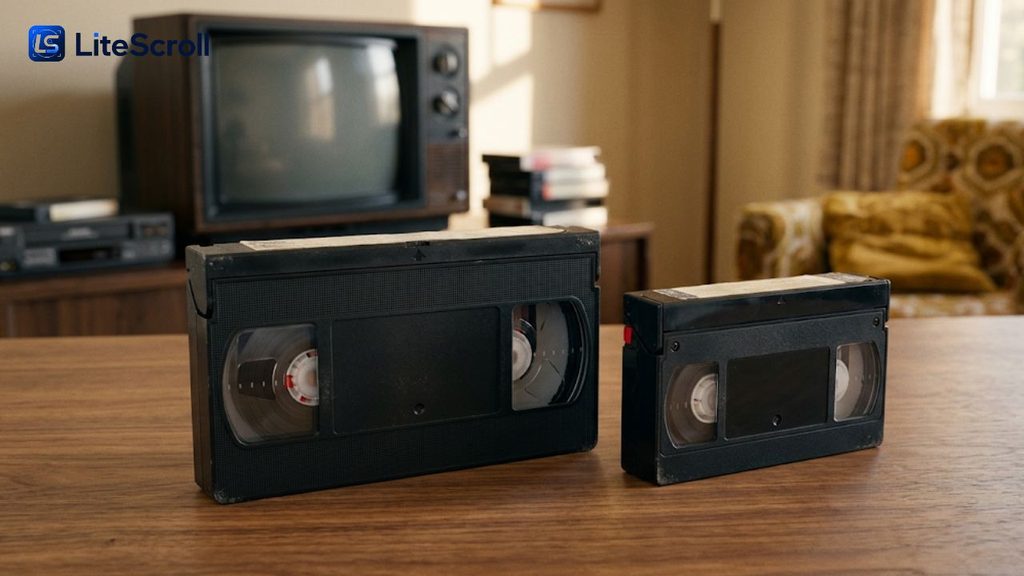
A box of family recordings can reveal an entire era of home technology. old VHS and Betamax cassettes may look similar at first glance, but they were competing formats with different machines, recording options, and histories. Today, their biggest shared challenge is not winning a format war. It is keeping birthdays, interviews, school performances, and ordinary family moments accessible before aging tapes or scarce playback equipment make them difficult to recover.
Where the Home Video Rivalry Began
Sony introduced Betamax for consumers in 1975. JVC followed with VHS in 1976. Both used magnetic tape housed in a cassette and allowed households to record or replay television and personal video. They arrived when watching a program at a chosen time was an exciting new possibility. Capture+1
The competition between old VHS and Betamax was not decided by picture quality alone. Early Betamax machines offered a modest image-quality advantage under certain recording conditions. VHS entered the market with longer recording time and a more widely licensed manufacturing approach. Those differences affected what people could record, how much equipment cost, and which format appeared in rental stores.
Why Recording Time Was So Important
Early consumer Betamax recording was commonly limited to about an hour at its original speed, while early VHS could record roughly two hours. That difference mattered when households wanted to capture a film or a lengthy sports broadcast without changing cassettes. Both technologies later introduced slower recording modes and longer-duration options, often with quality tradeoffs.
When examining old VHS and Betamax recordings, check the recording speed as well as the format. The longest advertised time on a cassette does not tell you the quality of the footage or whether a particular deck supports the mode used. An older recording may require compatible playback settings to look and sound its best.
How Retail Availability Shaped the Outcome
JVC licensed VHS to a broad group of manufacturers, helping establish many brands of compatible machines. Sony controlled Betamax more closely, and VHS gradually gained a large advantage in equipment availability and prerecorded movie distribution. Consumers often selected the format that their local shops and friends already used. iasa-web.org
The story of old VHS and Betamax illustrates how convenience and distribution can matter as much as technical specifications. A technically attractive recording system is less useful if the desired movie, blank tape, or affordable player is difficult to find.
Identify Which Cassette You Actually Own
A standard VHS cassette has a larger, wider shell than the more compact Betamax cassette. Both contain tape on two internal reels, but the shells and transport mechanisms are different. You cannot place a Betamax tape in a VHS machine or make it compatible by changing the label.
Before playing old VHS and Betamax media, inspect the entire collection and separate clearly identified formats. Look for printed format markings, cassette dimensions, protective cases, and handwritten recording notes. If you cannot identify a cassette confidently, compare it with reliable reference photographs or ask a transfer specialist. Never force an unfamiliar cassette into a deck. Videotape
Do Not Confuse Betamax With Betacam
Sony also developed professional Betacam recording systems, but Betacam is not simply another name for the consumer Betamax format. Similar-looking cassettes do not guarantee compatible recording signals or playback machines. The distinction becomes particularly important with recordings from news organizations or production studios.
Compare Picture Quality Without Repeating Myths
Betamax acquired a reputation for looking a little sharper than early VHS. There was some basis for that reputation in certain early machines and speed modes, yet the difference was not universal. Tape quality, recording speed, deck condition, signal generation, and years of storage all influence the result seen today.
For old VHS and Betamax tapes, the best surviving image may come from a well-preserved VHS recording rather than a damaged Betamax one. Higher-generation copies also look less clear than an original master. Avoid judging all recordings by an online comparison that fails to identify the specific decks and recording conditions.
What Digital Upscaling Can and Cannot Do
Ask for a faithful transfer of old VHS and Betamax material before requesting optional enhancement. If possible, retain an unmodified preservation copy and make a separate version for viewing or sharing. That way, later software improvements will not require returning to a fragile original tape.
Check Condition Before Pressing Play
Magnetic tape can deteriorate through physical damage, chemical changes, unsuitable storage, and repeated use. Problems may include mold, creasing, debris, damaged shells, and transport issues. A tape that looks normal externally can still produce unstable playback or strain a deck that has not been serviced in years. National Archives
When sorting old VHS and Betamax collections, check for moisture marks, visible mold, unusual odors, broken plastic, and loose or twisted tape. Do not attempt to play a visibly contaminated or jammed cassette in valuable equipment. A professional experienced with damaged media can advise whether inspection, cleaning, or repair is appropriate.
Choose a Working Deck Carefully
A compatible player is essential. An inexpensive machine from a secondhand listing may contain aging belts, dirty heads, or mechanical faults that risk damaging recordings. If you purchase a used deck, arrange sensible testing with nonessential media before inserting irreplaceable footage.
Owners of old VHS and Betamax tapes should resist repeatedly replaying a recording simply to see whether its picture improves. Playback introduces wear, and repeated attempts are particularly risky when the machine pulls tape unevenly. If a recording behaves strangely, stop and investigate the equipment and cassette condition.
Decide Between Home Conversion and a Specialist
A home transfer setup generally needs a functioning format-specific player, a compatible analog capture interface, suitable cables, a computer, and software to record the incoming video. You must monitor the playback because each tape typically transfers in real time. A large collection can therefore become a substantial project.
Digitizing old VHS and Betamax recordings at home may be reasonable when the tapes are in good condition and you already have reliable equipment. For rare formats, damaged cassettes, or irreplaceable family recordings, a reputable professional service may be more appropriate. Ask what formats it accepts and whether it inspects media before playback. National Archives
Questions to Ask a Transfer Provider
Find out whether the service uses genuine compatible players, what file formats it supplies, how it deals with damaged tapes, and whether it returns originals. Ask about audio synchronization, transfers of tapes with multiple recordings, privacy safeguards, and the process for resolving failed or incomplete transfers. Do not assume that a promise of “4K conversion” means new picture detail can be created.
For collectors comparing old VHS and Betamax transfer options, pricing should be evaluated against the actual deliverables. Clarify whether the quote includes cloud access, downloadable files, physical storage, shipping, special handling, and any optional restoration. Keep a written inventory of every tape sent away.
Build Digital Copies That Remain Useful
For ordinary family viewing, a well-encoded MP4 is often convenient because many phones, computers, and televisions can open it. For more demanding preservation projects, a higher-quality archival file may also be appropriate. Whatever format you choose, check that the picture, sound, running time, and frame shape are correct.
During the conversion of old VHS and Betamax footage, avoid stretching the original 4:3 image across a widescreen frame. Analog recordings may contain interlacing and other characteristics that require careful processing. A competent transfer should preserve the original content and explain any corrections made for modern playback.
Verify the Result Before Storing the Original
Open each completed file and inspect the beginning, middle, and end. Listen for missing audio, check that family members are not cut off at the edges, and confirm that a long cassette was not transferred only in part. Give files descriptive names based on the information you actually know, rather than inventing dates.
Preserving old VHS and Betamax recordings also requires backups. Keep multiple copies on separate storage devices or services, with at least one away from the primary computer. Periodically verify that the files still open and migrate them to supported storage as equipment changes. A single external drive is not a complete preservation strategy. National Archives
Keep the History Alongside the Video
Save the original cassette label, transfer date, known participants, approximate location, and any uncertainty about the event. A simple spreadsheet or text document can help relatives discover the footage later. The story attached to a recording may become as valuable as the video itself.
Store Tapes Safely While You Decide
Digital transfer does not always mean you must immediately discard the physical cassette. Originals may have sentimental value or serve as the source for future, higher-quality transfers. Store tapes upright in protective cases, away from damp areas, extreme heat, direct sunlight, dust, and strong magnetic fields. Stable indoor conditions are preferable to garages and attics.
Careful storage of old VHS and Betamax material buys time but does not stop aging indefinitely. Public preservation guidance emphasizes that magnetic media have finite lives and depend on increasingly difficult-to-maintain equipment. Prioritize unique family recordings ahead of replaceable commercial releases, especially if a cassette already shows deterioration. National Archives+1
Handle Privacy, Copyright, and Disposal Responsibly
Home videos may contain sensitive family moments, addresses, or recordings of children. Before donating tapes or sending them to a service, consider who could access the content and what privacy policies apply. A digital copy does not erase material from the original magnetic tape.
When disposing of old VHS and Betamax media, do not assume intact cassettes belong in curbside recycling. Their long magnetic tape can tangle sorting equipment. Seek a specialist media recycler or check your municipality’s precise acceptance rules. If the recordings are confidential, ask about secure destruction rather than ordinary donation.
Use the Historical Comparison to Protect Your Memories
Capture’s September 24, 2026 discussion of old VHS and Betamax explains how recording time, licensing, availability, and rental-market support shaped the formats’ competition. Its broader message is practical: whichever system a household adopted, the recording now depends on aging magnetic media and obsolete playback hardware. The article is a useful overview, but evaluate commercial transfer offers according to their current terms and your own needs. Capture
Learning about old VHS and Betamax is worthwhile for technology history, but preservation is the more urgent task for anyone with unique recordings. Identify the format correctly, avoid risky playback, choose an appropriate transfer workflow, and protect the resulting files. Those actions matter more than declaring one cassette the winner today.
Frequently Asked Questions
Can a Betamax cassette play in a VHS recorder?
No. The formats use different cassette shells and transport systems. A Betamax recording needs compatible Betamax playback equipment or a professional transfer service with the proper machine. A VHS-C adapter does not solve this incompatibility.
Was Betamax always sharper than VHS?
No. Some early Betamax modes and machines offered a modest advantage, but quality depended on recording speed, tape condition, equipment, and the original signal. A clean VHS recording may look better than a degraded Betamax recording.
Why did VHS become more popular?
Longer early recording time, broad manufacturer support, lower-cost equipment choices, and expanding movie-rental availability helped VHS gain market share. Consumers valued accessible machines and tapes as well as picture quality.
Can I convert both formats to MP4?
Yes, with suitable playback and capture equipment or an appropriate specialist service. Verify that the full recording and audio transferred correctly. Preserve an additional high-quality master when the footage is particularly valuable.
Is it safe to play a tape with visible mold?
Do not play it in ordinary household equipment. Mold or other contamination can harm the mechanism and potentially affect additional media. Ask an experienced audiovisual preservation provider to evaluate it.
Should I throw the original away after digitizing?
Not immediately. Check the digital files, create backups, and decide whether the original remains worth retaining. For disposal, follow local magnetic-media guidance and address privacy concerns before donation or recycling.
Conclusion
The competition between two home-video formats changed how families recorded and watched everyday life. Today, old VHS and Betamax cassettes deserve careful handling because both magnetic media and the machines that play them are aging. Identify each format, make a faithful digital transfer, and keep verified backups with useful descriptions. The lasting value is not the format that won the market, but the memories that survive it.