
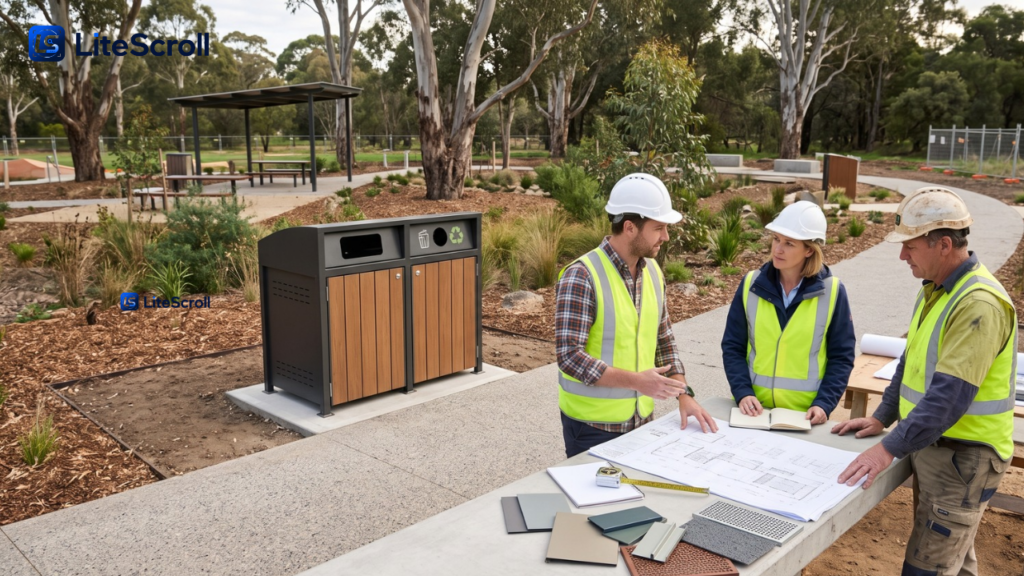
A busy park can have excellent paths, seating and landscaping yet still feel neglected when rubbish accumulates near its entrances. Well-planned bin enclosures make waste disposal easier to find, protect the bins inside and help maintenance teams keep public areas tidy. Their success depends on much more than an attractive metal cabinet: capacity, placement, signage, accessibility and collection routines all matter.
For Australian councils, landscape architects, schools and commercial precincts, the best approach begins with the people who use the space. This guide explains how to compare materials and designs, choose sizes, plan recycling stations and consider long-term costs without assuming one product suits every location.
Start With the Waste That People Actually Generate
Before ordering bin enclosures, observe where rubbish appears and when foot traffic is highest. A sports ground on Saturday may generate food packaging and drink containers, while a quiet walking trail might need fewer stations near entrances. A shopping strip brings different collection needs from a coastal picnic reserve. Use these patterns to establish a brief before selecting products.
Ask the cleaning team which existing bins overflow, where contamination occurs and how often vehicles visit. Check whether waste is generated at food outlets, picnic tables, bus stops or exits. An enclosure located only where it looks symmetrical on a plan may be missed by the people who need it.
Map Movement and Collection Routes
Locate bin enclosures where people can see and approach them without blocking a continuous pedestrian path. Consider prams, wheelchairs and people carrying food or bags. Then check how staff will remove the inner wheelie bin: service doors need clearance, and collection trolleys require manageable surfaces without avoidable steps or steep slopes.
The NSW Environment Protection Authority’s public-place recycling guidance addresses visibility, bin location, accessibility, collection safety and realistic management goals. These principles support a whole-site plan rather than a series of isolated purchases. EPA
Choose Capacity Based on Real Use
A compact station can suit a low-traffic garden, while a large event precinct may require multiple higher-capacity units. Common GX Outdoors options across its range include 65-litre, 120-litre and 240-litre configurations, although individual models have different availability. Do not assume the largest option is automatically best: it may be harder to position or service at a narrow site. GX Outdoors
When comparing bin enclosures, estimate expected waste volumes, peak-day demands and the existing collection schedule. If the facility regularly fills before its next pickup, consider increasing capacity, adding another location or changing collection frequency. More equipment is not always the only answer.
Single Stations Versus Paired Units
A single waste station may suit a small lookout, but paired rubbish and recycling units can support clearer sorting in busy destinations. Some bin enclosures are offered as dual configurations, while others are separate units positioned together. Confirm the exact product arrangement, opening positions and internal container dimensions before ordering.
Make Emptying Safe and Practical
Check door swing, locking hardware, wheelie-bin access and the weight staff must move. A high-capacity enclosure is not useful if a worker must pull a loaded bin across an unsuitable surface. Specify working clearances on drawings and involve the waste contractor early.
Help Visitors Put Items in the Correct Stream
A waste station should tell users what belongs inside before they reach the opening. In Australia, red generally identifies rubbish, yellow commingled recycling, blue paper and cardboard, and lime green organics under the applicable colour guidance. Nevertheless, accepted materials vary by local collection contract, so do not use colour alone as a universal sorting instruction.
Effective bin enclosures combine clear words, recognisable pictures and appropriately differentiated openings. Place labels where they remain visible when people approach from typical walking routes. NSW EPA guidance provides standard recycling signs and references AS 4123.7 for mobile waste-container colours; confirm the relevant standard and local arrangements for your installation. EPA
Reduce Contamination Without Creating Confusion
Avoid vague instructions such as “recyclables only” when the local system excludes particular packaging. Show familiar accepted and rejected items based on the collector’s current requirements. For bin enclosures in a food court or picnic area, think carefully about greasy packaging, liquids and food scraps that can contaminate otherwise useful materials.
Consider reviewing the contents of a sample of bins after installation, using safe and appropriate procedures. If the problem is persistent, adjust signage, opening shape or station placement before assuming visitors are simply ignoring instructions.
Select Materials for the Australian Climate
The same design may face different stresses in Darwin, Melbourne and a coastal New South Wales reserve. Rain, UV exposure, salt air, cleaning chemicals and heavy public use all influence material choices. Durable bin enclosures should use an appropriate combination of cabinet material, protective finish, hardware and drainage details rather than relying on a generic claim of weather resistance.
Metal Cabinets and Protective Finishes
Powder-coated steel can provide a robust enclosure, while aluminium panels may offer a different weight and corrosion profile. Stainless steel components are useful in some exposed settings, but grade, surface finish and maintenance still matter. Ask for specifications for each component, including hinges, locks, fasteners and chutes, rather than judging only the exterior photograph.
Coastal Sites Need Closer Attention
For bin enclosures near beaches or marine environments, discuss salt exposure with the supplier. Compatible metals, protective coatings, drainage and a reasonable cleaning schedule can all influence service life. Scratches and trapped moisture deserve attention even when the product is sold for outdoor conditions.
Think About Heat, Odour and Water
An enclosed cabinet can make a precinct look tidier but should still support appropriate ventilation and cleaning. Check whether the design prevents standing water and allows residue to be removed. A completely sealed appearance is not necessarily a practical solution for wet or food-contaminated rubbish.
Review Security Without Sacrificing Serviceability
Public equipment may be pushed, struck or used incorrectly. Lockable service doors can help prevent casual tampering, while sturdy hinges and accessible replacement parts reduce future maintenance headaches. Bin enclosures should balance secure containment with quick, safe access for authorised staff.
Ask what key type the proposed model uses, whether standard service keys can be supplied and how replacement locks are obtained. Also consider what happens if a lock fails during collection. Avoid design choices that encourage cleaners to leave doors unsecured simply because access is too cumbersome.
Position Openings With Users in Mind
An opening should be easy to locate and reach, including from an accessible route. The surrounding pavement, approach space and height can matter as much as the opening itself. Do not assume that specifying an “accessible” product makes the complete site compliant with the applicable access requirements. Seek qualified advice for the particular project.
Compare Actual Product Options, Not Just Catalogue Photos
Councils and project managers examining bin enclosures can review the GX Outdoors collection, which lists models such as Urbania, Integra EX, Streetstyle, Metro, Citistyle and Bondi. The range offers different cabinet forms, finishes and configurations, so the supplier’s product-specific drawings are more informative than treating the catalogue as one uniform specification. GX Outdoors
For example, GX Outdoors describes Metro with powder-coated aluminium panels, a stainless steel chute and a lockable service door, while Integra EX is listed with powder-coated zinc steel and 120-litre or 240-litre options. Urbania includes choices for decorative panels and customised imagery. These are manufacturer descriptions, not independent durability tests; verify exact specifications and warranty conditions for the selected model. GX Outdoors+2
When comparing bin enclosures, also ask about available signage kits, finishes, replacement components and whether custom branding affects lead time or price. GX Outdoors says its enclosure range is delivered assembled, but transport, unloading, anchoring and site preparation should still be clarified before purchase. GX Outdoors
Coordinate Installation With the Wider Landscape
The cabinet footprint is only one part of the space required. Allow for door opening, bin withdrawal, staff movements and visitors approaching from different directions. Locate bin enclosures away from narrow crossings and outside circulation zones needed for seating, fountains or bicycle parking.
Check Ground Conditions and Fixings
Ask a designer or installer to verify the paving, footing or slab arrangement for the selected model and its expected use. Public equipment may require secure anchoring, but the fixing method depends on the product and site. Identify underground services before drilling or excavating, and resolve any local approval requirements in advance.
Match the Precinct’s Appearance
Colour and architectural form can help bin enclosures fit a heritage street, modern civic plaza or natural parkland. Consistent visual design is useful, but avoid sacrificing label contrast and easy identification of waste streams purely to match the surrounding furniture. Branding is most effective when visitors can still tell the bins apart immediately.
Plan Maintenance Before the Handover
An enclosure that is beautiful on opening day can quickly become an eyesore without cleaning responsibilities. Decide who empties the inner bin, washes the cabinet, removes stickers, checks locks and repairs damaged panels. Regular inspections for pests, spills and overflowing contents should reflect site activity and local waste-management procedures.
For bin enclosures in busy public spaces, write down a realistic cleaning and inspection schedule before the contract is signed. Make sure staff can obtain replacement keys, signage and components. Document defects promptly rather than allowing small failures to interrupt the entire waste station.
Compare Whole-Life Costs
The full price includes procurement, freight, installation, cleaning, waste collection, repair and eventual replacement. A cheaper model may represent good value, but that decision should be supported by maintenance requirements and parts availability. Bin enclosures with replaceable components can sometimes reduce the need to discard an otherwise sound cabinet.
Look for written warranty terms and exclusions rather than broad claims of maintenance-free operation. A supplier’s general maximum warranty statement may not apply to every finish or part.
Build a Clear Procurement Checklist
Before approving bin enclosures for a new park, school or shopping precinct, ensure that the landscape architect, waste-service team and access adviser have reviewed the same design. A short specification can prevent problems that are expensive to fix once units are anchored.
- Record peak visitor demand, waste streams and collection frequency.
- Select container capacity and the appropriate number of stations.
- Confirm accessible approach space, service access and door clearance.
- Specify finishes, locking details, signage and drainage requirements.
- Compare supplied equipment, installation tasks and complete costs.
- Request product drawings, warranty information and maintenance instructions.
- Assign responsibility for future cleaning, repairs and waste audits.
Keep the final drawings, product identifiers and supplier contacts in the asset register. That makes future changes easier when a precinct expands or recycling arrangements change.
Frequently Asked Questions
What are these cabinets used for?
They house waste or recycling containers in parks, streets and other shared spaces. Well-positioned bin enclosures can improve the appearance of a precinct and help visitors find disposal points, but they still need clear signs and reliable collection services.
Are 120-litre and 240-litre options available?
Yes, GX Outdoors advertises those sizes on multiple models, while its wider range also lists 65-litre options. Check the exact product and interior container compatibility before ordering rather than assuming every design comes in every size.
Can public waste stations support recycling?
Yes. Many bin enclosures can be configured or paired for separate rubbish and recycling streams. The labels must reflect what the local collection service actually accepts, because recycling rules are not identical everywhere in Australia.
Which finishes suit coastal parks?
Suitable protective coatings, compatible fasteners and appropriate corrosion-resistant components are important. Ask for a product-specific specification and a coastal maintenance plan; no finish should be treated as immune to salt damage or wear.
Do these products arrive assembled?
GX Outdoors says its enclosure range is supplied fully assembled. However, the buyer must still clarify freight, delivery access, unloading and installation responsibilities. A fully assembled cabinet is not necessarily ready to use without site work.
What should councils compare before buying?
Evaluate capacity, sorting clarity, access, servicing, materials, locks, installation scope and whole-life costs. For bin enclosures at heavily visited sites, involve the collection contractor and cleaning staff before approving the final layout.
Conclusion
Successful public waste stations combine easy disposal, clear sorting, accessible placement and practical maintenance. Choosing bin enclosures should begin with the site and its users, then move to capacity, materials and supplier-specific details. Confirm installation responsibilities and long-term costs instead of relying on catalogue appearance alone. The result can be a cleaner, better organised public space that remains manageable for the people who care for it.