
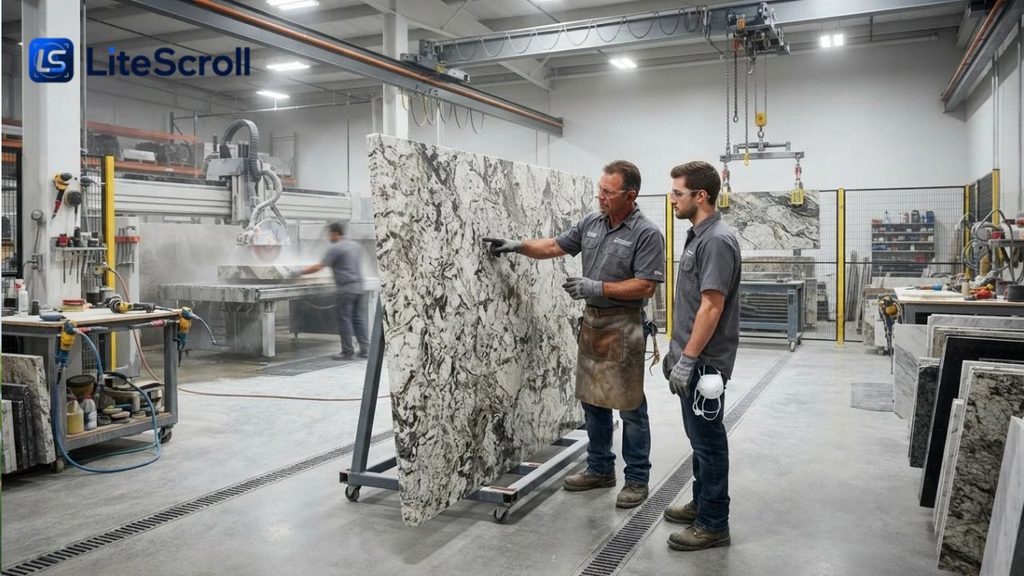
Beautiful marble counters and dramatic stone walls depend on much more than the appearance of a slab. Someone must measure accurately, select appropriate fabrication methods, manage heavy materials, and install the finished work safely. For homeowners and project teams, natural stone accreditation offers one way to assess whether a company has undergone an independent review of its capabilities. It is a useful qualification, but it does not replace careful project planning or a detailed contract.
The Natural Stone Institute (NSI) runs a company-level accreditation program for countertop fabricators and commercial stone installers. Understanding its scope can help buyers compare credentials without assuming that every badge, membership, or professional title means the same thing. This guide explains what the program examines, who it serves, and the questions to ask before hiring a contractor in the United States. Accreditation
Why Independent Qualifications Matter
Natural stone projects bring together design, engineering, material handling, and workmanship. Even a small kitchen countertop must be measured and supported correctly. A commercial facade adds more complex questions about anchorage, building movement, weather exposure, and the approved design. Impressive photographs reveal little about a company’s training, equipment, or safety practices.
That is where natural stone accreditation becomes relevant. NSI describes its program as third-party verification of company qualifications rather than a personal certificate for an individual installer. It examines operational practices and technical competence, providing a starting point for due diligence. Accreditation still does not guarantee that a particular job will be defect-free, and buyers should evaluate the proposed team and work scope separately.
Distinguish Membership From Accreditation
An association membership signals a relationship with an industry organization, but it is not automatically evidence that the member passed a formal qualification review. Likewise, a manufacturer training badge may cover a specific product without examining the contractor’s overall operations. Ask which credential a business actually holds and which services it covers.
With natural stone accreditation, confirm the company’s exact listing and designation in the official directory. A similarly named business, a former employee’s qualification, or a logo on a brochure should not substitute for verification of the company you intend to hire.
What the Institute Evaluates
The program’s published criteria cover multiple aspects of a company’s operation. NSI identifies quality control, safety, technical expertise, physical facilities and equipment, customer service, ethical practices, financial resources, and employee training among its review areas. The credential therefore addresses more than a polished showroom or a single successful project. Why Select an Accredited Company?
Technical Knowledge and Quality Controls
Fabrication calls for accurate templating, appropriate edge finishing, material assessment, and careful handling. Installation also demands attention to substrate conditions, support, joints, and site coordination. For natural stone accreditation, evaluators consider whether a business has the knowledge and processes suited to its designation, not simply whether it can produce a decorative sample.
Buyers should still ask to see work similar to their proposed project. A firm experienced with kitchen countertops may not be the right team for structural exterior cladding. Photographs, references, shop drawings, and a discussion of tolerances can help establish how the contractor’s experience matches the job.
Workplace Safety and Business Practices
Stone slabs are heavy, and cutting some stone materials can generate hazardous airborne dust. A credible contractor should explain how it controls lifting risks, protects workers, maintains equipment, and organizes the workplace. Clear agreements, reliable communication, and documented change procedures also affect whether a job succeeds.
Natural stone accreditation evaluates these broader practices, but the responsibility to comply with applicable safety laws remains with the employer. Never assume the credential grants an exemption from regulations or removes the need to check site-specific hazards.
Understand the Three Company Designations
NSI identifies three accreditation categories. Selecting a company with the correct designation is more meaningful than treating every accredited business as interchangeable. Accreditation Resources for Design Professionals
Accredited Fabricator
This designation focuses on countertop fabrication and other non-engineered residential or commercial interiors. It is the category most relevant to many kitchen, bathroom, and interior countertop projects. Natural stone accreditation in this category is not a blanket authorization to engineer high-rise facade systems or take on work outside the company’s experience.
Commercial B Contractor
Commercial B addresses general commercial stone installation, including interior projects and lower-rise cladding. Its scope matters for designers specifying stonework in offices, hospitality properties, and similar developments. Confirm the exact responsibilities for fabrication, engineering, and installation rather than assuming one contractor handles everything.
Commercial A Contractor
Commercial A focuses on heavy commercial work, including large-scale engineered high-rise cladding. NSI says companies in this category are also qualified for work covered by Commercial B. Such projects may involve engineered attachments, structural design coordination, and demanding inspection requirements.
Match the Credential to the Actual Scope
Before citing natural stone accreditation in a specification, decide whether the project needs an interior fabricator, a general commercial installer, or a heavy commercial contractor. The appropriate designation depends on what the contractor will do, not how prestigious the label sounds.
How the Review Process Works
NSI’s published description outlines a multi-step process involving documentation review, a written examination, and an on-site inspection. The review considers the company’s facilities and operational practices alongside technical knowledge. These steps help explain why accreditation is more substantial than simply paying to appear in a directory. Why Select an Accredited Company?
Businesses pursuing natural stone accreditation should consult the current application and handbook for eligibility, fees, required documentation, and any ongoing obligations. Program details can change, so an old application or social-media description is not a dependable basis for planning. Buyers should likewise check present status instead of assuming a contractor’s historical credential remains active.
Seven Checks Before Hiring a Stone Contractor
1. Verify the Company’s Identity
Search the official NSI directory by location and designation. Confirm the business name, relevant location, and services offered. If the quoted work will be performed by a subcontractor, ask which company is responsible for fabrication and installation and whether its qualifications have been verified.
Natural stone accreditation is awarded to companies, so the identity of the contracting party matters. A brand name on a quotation does not clarify every responsibility unless the written agreement does.
2. Examine Comparable Completed Work
Request photographs and references from projects similar in stone type, size, and complexity. Ask how the contractor handled unusual layouts, seams, support, and any problems that emerged. A recent kitchen installation is more useful evidence for a kitchen project than an unrelated lobby photograph.
3. Discuss Safety and Site Access
Ask about slab transport, lifting equipment, occupied-building protection, dust controls, and the personnel who will supervise the work. Find out whether the team expects any cutting or drilling inside your property. A sound answer should explain protective methods without minimizing potential risks.
4. Confirm Insurance and Local Requirements
Request appropriate evidence of liability insurance and workers’ compensation coverage, where applicable. Check state or local licensing and permitting requirements for the work. Natural stone accreditation complements these checks; it does not replace required registrations, trade licenses, or project approvals.
5. Review the Technical Scope
Request written details for materials, thickness, exposed edges, seams, cutouts, support, installation method, and finishing. Commercial projects may need engineered drawings and independent inspections. For countertops, confirm who verifies dimensions after cabinets and appliances are installed.
6. Compare Complete, Itemized Quotes
Look beyond the stone price. Delivery, site preparation, cutting, edge profiles, sealing where appropriate, demolition, disposal, and installation can affect the final amount. Ask how changes and discovered problems will be priced. Comparing equal scopes is more informative than comparing two bottom-line numbers.
7. Agree on Inspection and Follow-Up
Confirm the schedule, communication contact, protection of adjacent finishes, punch-list process, and warranty terms. Natural stone accreditation offers background assurance about evaluated company practices, but a specific agreement establishes who must correct damage, incomplete work, or installation defects on your project.
Pay Special Attention to Silica and Slab Handling
Natural and engineered stone work can expose workers to respirable crystalline silica when silica-containing materials are cut, ground, or polished. OSHA and NIOSH issued updated hazard guidance in 2026 for countertop manufacturing, finishing, and installation. Applicable OSHA rules differ between construction and general industry operations, and employers must follow the standard relevant to their work. CDC+1
When evaluating natural stone accreditation alongside safety procedures, ask about engineered controls such as wet methods and appropriate dust extraction, worker training, and safe cleaning practices. Specific controls depend on the activity and material. An ordinary household vacuum or open window is not an adequate substitute for professional exposure control when hazardous dust is being generated.
Stone handling introduces separate hazards from falling slabs and unstable loads. Visitors should stay clear of fabrication and lifting zones. Homeowners should not attempt to reposition heavy slabs themselves. Use trained crews with suitable equipment and confirm the proposed installation route before the delivery day.
Plan a Better Kitchen or Commercial Installation
Early design decisions influence workmanship. For a kitchen, finalize cabinets, sink selection, appliance dimensions, and access before templating. Ask how natural veining will run across adjoining sections and where seams are proposed. Photos of selected slabs can help, but inspect the actual material if practical because natural patterning varies.
Natural stone accreditation is most valuable when combined with clear design communication. Agree on acceptable visual variations, edge details, cutout locations, and the process for approving layouts. On commercial projects, require coordination between the architect, engineer, general contractor, and qualified stone installer where appropriate.
Do Not Confuse a Credential With a Material Warranty
Accreditation assesses a business, while stone warranties and installation workmanship warranties may cover different issues. Natural features such as veining or small mineral inclusions are not necessarily defects. Clarify which conditions are expected characteristics and which problems the supplier or installer will address.
Use the Official Program as a Starting Point
The Natural Stone Institute (NSI) explains its accreditation program and links visitors to company searches, qualification information, and resources for specifiers. NSI’s public descriptions distinguish accredited fabricators from two commercial installation designations, helping buyers identify the kind of experience most relevant to their plans.
For natural stone accreditation searches, consult the directory and then contact shortlisted contractors directly. Confirm current credentials, project availability, the named installation team, and applicable insurance. A verified designation can strengthen your shortlist, but it should not be the only basis for selecting a contractor.
Frequently Asked Questions
Is an accredited company guaranteed to deliver perfect work?
No. Natural stone accreditation indicates that a company passed an independent qualification process within its designation. Project outcomes still depend on design, materials, site conditions, supervision, and a suitable contract. Check references and inspect completed work before making a final payment.
Does this credential apply to individual installers?
NSI states that its program accredits companies rather than individual workers. Confirm the company’s designation and ask who will actually manage your project. Personal experience and relevant technical training remain important, but they are separate from company accreditation.
Are all natural stone contractors required to hold it?
No universal U.S. rule requires every stone contractor to obtain natural stone accreditation. Legal obligations for licensing, insurance, safety, and permits depend on the location and work performed. Accreditation is a separate voluntary credential that can support contractor selection.
Which designation is appropriate for countertops?
The Accredited Fabricator designation covers countertops and other non-engineered residential or commercial interior work. Complex commercial installation or engineered cladding may require a contractor with an appropriate commercial designation and additional project-specific qualifications.
Does it prove the stone is sustainably sourced?
Not by itself. Natural stone accreditation evaluates contractor qualifications, not the complete environmental history of a slab. NSI also has separate sustainability programs and resources. Request sourcing and environmental documentation if those considerations matter to your project. For Design Professionals
What if there is no accredited company nearby?
You can still evaluate qualified contractors using references, applicable licenses, insurance, comparable work, safety practices, and detailed proposals. Natural stone accreditation is a useful screening factor, but geographic availability and project-specific competence should guide a responsible decision.
Conclusion
Choosing a stone contractor is about more than comparing slab colours and installed prices. Natural stone accreditation provides a meaningful way to examine independently reviewed company qualifications, especially when the designation matches the project. Verify current status, assess safety and technical competence, and put the work scope in writing. These steps give homeowners and construction teams a stronger foundation for lasting, well-executed stonework.