
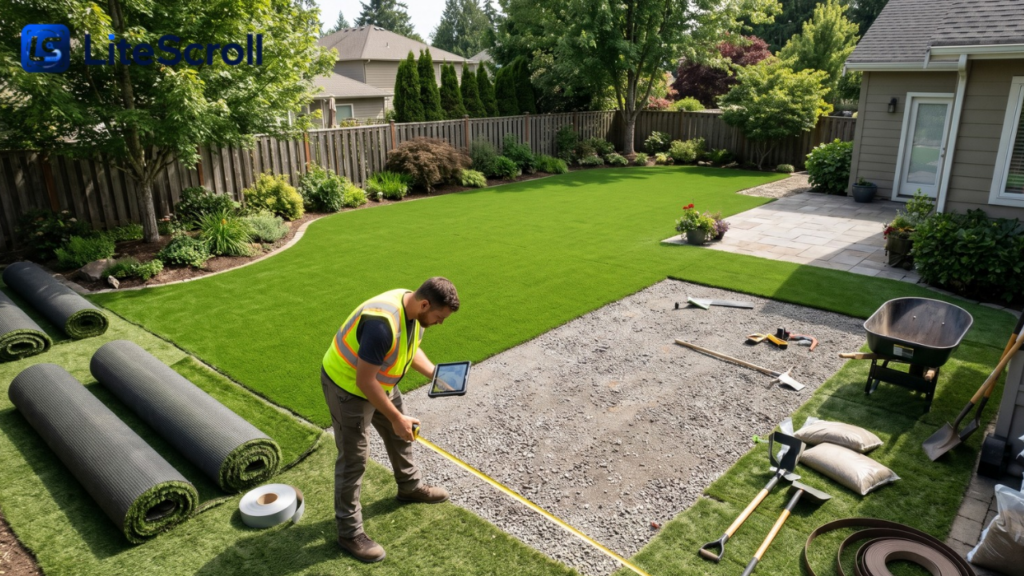
Replacing a patchy lawn with synthetic turf can simplify mowing and improve how a yard looks, but the installation price deserves careful planning. An artificial grass cost calculator provides a useful starting estimate by combining your project’s size with a pricing assumption. It cannot, however, see buried roots, poor drainage, or difficult access from a screen.
For U.S. homeowners, the smartest approach is to estimate the area, understand what the rate includes, and then compare detailed local bids. This guide explains how to use an artificial grass cost calculator without mistaking a preliminary number for a guaranteed installation price.
What Should You Expect to Pay?
Published national estimates vary because providers measure projects differently. Lawn Love’s October 2026 guide reports approximately $5.45–$20 per square foot installed, while LawnStarter’s October 2026 guide gives $15–$19 per square foot for its surveyed projects. Those figures are market references, not promises about your particular property. lawnlove.com+1
An artificial grass cost calculator is most helpful when you treat its result as a budget range. A 500-square-foot yard at a hypothetical installed rate of $12–$18 per square foot would cost $6,000–$9,000 before any extras excluded from that rate. Your contractor’s final number might sit outside that illustration.
Build Your Estimate in Five Practical Steps
1. Measure the Surface, Not the Entire Lot
Start with the specific zones you intend to cover. For a rectangle, multiply length by width in feet; a 20-by-12-foot patch measures 240 square feet. Divide irregular yards into rectangles and triangles, calculate each section, and add the areas together.
A map-based artificial grass cost calculator can help with awkward boundaries. For example, Smart Synthetic Turf’s artificial grass cost calculator lets users outline an installation area on an interactive map. Its own guidance says results are starting estimates and recommends on-site measurements before committing to a final quote. Smart Synthetic Turf LLC
2. Allow for Offcuts and Roll Layout
Measured ground coverage and the quantity of turf you must purchase are not always identical. Rolls have fixed widths, and complex curves or narrow strips can create offcuts. Ask suppliers about available roll dimensions and whether leftover pieces can be used without creating awkward seams.
When testing an artificial grass cost calculator, consider a separate material allowance if the tool only measures finished coverage. For illustration, adding 10% to a 240-square-foot layout produces 264 square feet of purchasable material. That percentage is a planning example, not a universal waste rule; an installer should calculate the actual cutting plan.
3. Choose a Consistent Price Basis
Decide whether you are budgeting for professional installation or buying turf for a do-it-yourself project. A full installed rate is convenient for early comparisons, provided the contractor defines its scope. A materials-only calculation requires you to add tools, base aggregate, edging, infill, transport, and any hired labor.
Never add full labor and base costs again to an artificial grass cost calculator result that already includes them. Instead, identify exclusions first. This simple check prevents an inflated total that can make otherwise reasonable proposals look unaffordable.
4. Account for Ground Preparation
The existing surface may need sod removal, excavation, disposal, grading, and compacted aggregate. Soft or uneven soil can require additional work. Drainage design should reflect local rainfall, soil conditions, and how water moves toward buildings or neighboring properties.
An artificial grass cost calculator often uses generalized assumptions about site preparation. Ask whether the quoted price includes removing the existing lawn, supplying the base, handling debris, and protecting irrigation or utility lines. Unexpected excavation can change the estimate more than a small difference in turf color or blade height.
5. Add an Appropriate Buffer
Once you understand the quoted scope, reserve a modest contingency for conditions not visible before work begins. The amount depends on site uncertainty and your tolerance for surprises; it should not replace a proper inspection.
A Worked Budget Example
Imagine a simple 240-square-foot backyard. At a hypothetical all-in installed rate of $12–$18 per square foot, the starting range is $2,880–$4,320. If a contractor identifies a drainage repair costing $600 outside that quoted scope, the revised illustration becomes $3,480–$4,920.
Six Factors That Change the Final Quote
Turf Fiber, Density, and Intended Use
Products differ in fiber material, pile height, density, backing, and warranty terms. Polyethylene products often target a softer residential feel; nylon can offer stiffness suited to demanding applications, typically at a higher material price. Compare physical samples instead of assuming the most expensive turf is automatically the best.
Base Construction and Soil Conditions
A professional installation is more than green carpet over bare dirt. Base thickness, aggregate selection, compaction, and grading affect how the surface holds its shape. The right design depends on site conditions, so an installer should explain what will be placed beneath the turf and why.
Drainage and Water Management
Artificial turf has drainage openings, but runoff still depends on its underlying construction. A yard that already pools water may require corrective grading or a more involved drainage system before turf is installed. The University of Florida’s IFAS researchers also caution that compacted systems can alter infiltration and runoff. News
Shape, Access, and Edging
Straightforward rectangles typically require less cutting than curved borders, pathways between pavers, or narrow strips. Limited access can mean extra labor to move aggregate and equipment through a side gate. Edging must also be specified so turf remains secure at boundaries.
Pets, Children, and Specialized Areas
Pet areas may need suitable drainage, more frequent rinsing, and an appropriate cleaning routine. Play areas may require separate impact-attenuation design and testing for their intended use; a pleasant-looking lawn is not automatically an impact-rated playground surface.
For these projects, adjust your artificial grass cost calculator assumptions to reflect suitable products and installation methods. Ask contractors for written specifications rather than relying on broad claims such as “pet-proof” or “safe for every playground.”
Local Labor and Project Size
Labor rates, disposal fees, material delivery, and contractor minimum charges differ across U.S. regions. Small installations can carry a higher cost per square foot because crews still incur travel and setup costs. Very large or unusual sites may also need specialized equipment.
Read Online Calculator Results Correctly
Useful online tools show area, assumed unit price, and an estimated project total. More advanced ones let you adjust materials or installation choices. Even a basic estimator becomes more valuable when you understand the calculation behind it.
The core formula is simple: measured square footage × applicable price per square foot = preliminary cost. If materials, preparation, and labor are priced separately, total those components once and add clearly identified extras.
Compare Like-for-Like Quotes
Ask every bidding contractor to use the same measured area and describe the same intended purpose. Request line items for turf product, base preparation, drainage work, edging, infill, seams, cleanup, and warranty coverage. Clarify whether tax and disposal charges are included.
A result from an artificial grass cost calculator gives you a useful reference when reviewing bids. A lower price may reflect excellent efficiency, but it may also omit work that another installer considers essential. Always compare the specification, not just the final dollar amount.
Questions Worth Asking During a Site Visit
Ask how the installer will manage runoff, how much excavation is included, which turf system is proposed, and what happens if unsuitable soil is discovered. Confirm who handles underground utility locating and whether required approvals or association rules have been checked.
You can also consult an experienced specialist before selecting a system. For example, Smart Synthetic Turf introduces Catalin Chiticaru as its founder and a synthetic turf construction professional on its expert page. His published background emphasizes base preparation, grading, and drainage—topics worth discussing with any prospective installer. Smart Synthetic Turf LLC
Is DIY Installation Actually Cheaper?
Doing the work yourself may reduce paid labor, but supplies and equipment still cost money. You may need a compactor, cutting tools, aggregate deliveries, disposal arrangements, and assistance positioning heavy turf rolls. Mistakes in grading or seams can be expensive to correct.
For a fair comparison, run your artificial grass cost calculator with a materials-only scenario, then add realistic rental and delivery costs. Compare that total with a professional bid that includes cleanup and a documented warranty. Your available time and experience should influence the decision too.
Consider Ownership Costs, Not Just Installation
Cleaning, Repairs, and Replacement
Synthetic turf reduces mowing and routine lawn fertilization, but it does not eliminate upkeep. Leaves still collect, fibers may need brushing, and pet waste requires attention. Some systems need infill maintenance, and damaged sections can require repairs.
An artificial grass cost calculator usually describes initial expenditure, not lifetime expense. Build a separate annual budget for cleaning supplies, occasional professional service, and eventual replacement. Compare that with actual local costs of watering, mowing, and maintaining a natural lawn rather than assuming universal savings.
Heat and Environmental Trade-Offs
Artificial surfaces can become extremely hot in direct sunlight. UF/IFAS researchers warn that surface temperatures may exceed 160°F under some conditions, posing concerns for bare feet and pets. Shade planning and checking the surface before use matter, especially in hot climates. News
Synthetic turf also does not provide the same habitat, soil benefits, or cooling function as living vegetation. Discuss runoff and end-of-life disposal before treating a lower water bill as proof of an overall environmental benefit.
Ways to Control Costs Without Cutting Corners
Start by choosing only areas where artificial turf solves a real problem. Retaining natural landscaping or planting beds elsewhere can reduce coverage while preserving shade and habitat. Simple boundaries also make purchasing and installation easier.
Use an artificial grass cost calculator to test different project sizes and product grades. Request two or three itemized bids, compare samples in outdoor light, and ask whether access or scheduling can be improved without sacrificing proper base work.
Common Estimating Mistakes to Avoid
Save the inputs from your artificial grass cost calculator, including square footage and assumed unit rate. When bids arrive, update your worksheet with documented inclusions instead of relying on memory. A transparent estimate is more useful than a suspiciously precise one.
Frequently Asked Questions
How accurate are online turf estimates?
An artificial grass cost calculator can provide a reasonable preliminary range if your measurements and pricing assumptions are sound. It cannot confirm hidden ground conditions, so an on-site quote remains necessary for a reliable project budget.
What size lawn can I estimate myself?
You can measure most simple rectangular areas with a tape measure. For an irregular yard, divide the space into smaller shapes or use an artificial grass cost calculator with a map-based drawing feature, then confirm the result on site.
Does the price include removing old grass?
Not necessarily. Some installers include excavation and disposal in their installed rate, while others quote them separately. Ask for a written scope before assuming those services are included.
How much should I budget for a 500-square-foot yard?
At a purely illustrative installed price of $12–$18 per square foot, the total is $6,000–$9,000. An artificial grass cost calculator can help explore different assumptions, but local site conditions and actual proposals determine the final price.
Is synthetic grass completely maintenance-free?
No. It avoids mowing, but cleaning, debris removal, brushing, and sometimes infill care remain important. Pet use and heavy traffic can increase the frequency of maintenance.
Should I prioritize the cheapest quote?
Usually not. Compare product suitability, base design, drainage, cleanup, warranties, and contractor experience. A well-defined scope gives you a better basis for deciding whether a lower bid represents genuine value.
Conclusion
A successful turf budget begins with accurate measurements, consistent pricing assumptions, and a clear understanding of what installation involves. Use an artificial grass cost calculator to explore realistic scenarios, not to replace an inspection or a detailed written quote. When you account for drainage, materials, maintenance, and the way your yard will be used, you can make a more confident decision about whether synthetic turf is worth the investment.